

Raising rent is one of the more delicate parts of owning a rental property. Owners need enough income to cover rising operating costs, but a poorly handled increase can frustrate a good tenant and create an unnecessary vacancy.
For Bothell rental owners, the process also has to follow Washington’s current rent stabilization and notice requirements. Gregory Property Management works with rental owners navigating these kinds of lease and rent decisions while balancing property performance with tenant retention.
Key Takeaways
- Worried about losing a reliable tenant? Use market data and a reasonable increase instead of automatically pushing to the highest possible rent.
- Unsure what Washington allows? Understand the current annual cap, timing rules, required notice, and possible exemptions before setting the new rent.
- Concerned about tenant pushback? Explain the business reasons for the adjustment early and clearly.
- Trying to avoid costly mistakes? Use the required written notice format and proper service method.
- Balancing cash flow and vacancy risk? Compare the value of a proven tenant against the income gained from a larger increase.
Start With the Legal Limits Before Choosing a New Rent
The first question should not be, “How much more can I charge?” It should be, “What increase is legally available for this tenancy?”
Washington law generally prevents a landlord from increasing rent during the first 12 months of a tenancy. After that period, covered residential tenancies are subject to an annual limit based on 7% plus the Consumer Price Index or 10%, whichever is lower. For 2026, the published maximum annual increase for covered residential properties is 9.683%, although certain properties and situations may qualify for exemptions.
Washington’s rent stabilization requirements(opens in new tab) outline the current annual limits and related requirements. The state’s residential landlord-tenant rules(opens in new tab) provide additional context for residential rental requirements.
Washington landlord-tenant law requirements also affect how owners handle rent changes and other lease-related decisions.
Use the Market as a Reference, Not an Excuse

A legal maximum is not automatically the right increase.
Compare the property with similar rentals in Bothell, including property type, bedroom count, condition, location, parking, upgrades, and included utilities. A supported increase is easier to explain than an arbitrary number.
Understanding how rental properties are priced in Bothell can help owners determine whether the current rent is below, near, or above comparable homes.
If your tenant is already close to market rent, a smaller adjustment may make more financial sense than pushing aggressively upward. A dependable tenant who pays on time, communicates well, and takes care of the home has real value.
Calculate the Cost of Losing a Good Tenant
Higher rent can improve monthly income, but vacancy and turnover can quickly erase that gain.
Suppose a larger increase adds another $100 per month compared with a more moderate option. That is $1,200 over a full year if the tenant stays. If the increase causes the tenant to move, the owner could face vacancy, cleaning, repairs, marketing, leasing work, and the uncertainty of a new tenancy.
The decision should consider total return, not just the new monthly rent.
The process of increasing rent without losing a tenant often comes down to balancing higher income against the value of keeping a dependable resident.
Give Tenants Context Before the Formal Notice

Rent increases usually go better when tenants understand why they are happening.
Keep the explanation factual and professional. Operating costs may have increased, the property may be priced below comparable rentals, or both may be true. Sharing that context helps make the adjustment feel like a business decision rather than a surprise.
Decide what increase makes sense, verify that it complies with the law, and then communicate consistently. When appropriate, landlords can recognize an excellent tenant by choosing an increase below the maximum they could otherwise charge.
Retaining a reliable resident at a slightly lower rent can sometimes be more financially beneficial than maximizing the monthly rental rate.
Follow Washington’s 90-Day Notice Rule Carefully
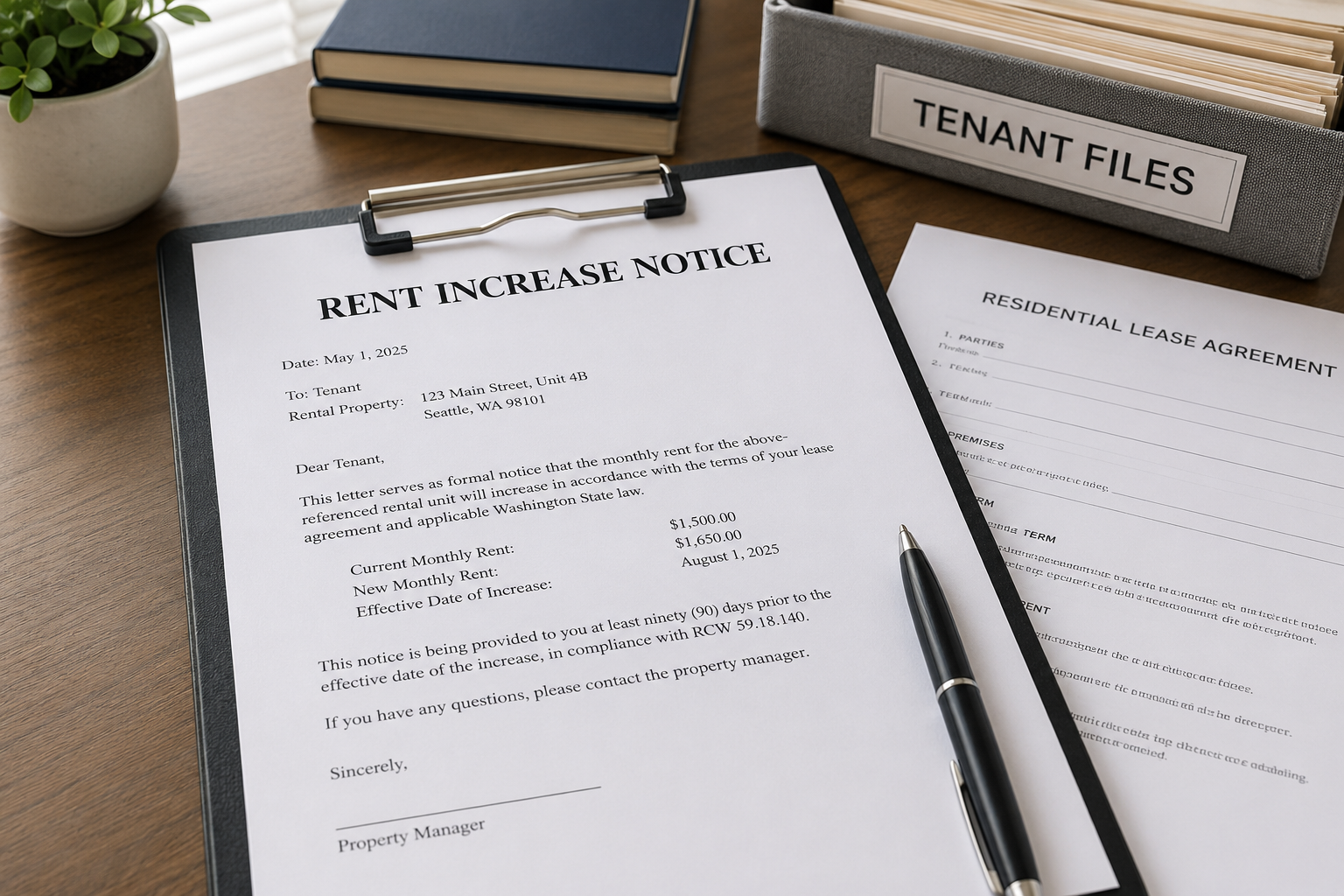
For most covered residential tenancies, Washington requires at least 90 days’ written notice before a rent increase takes effect. The increase also cannot take effect before completion of the applicable rental term.
The notice is not simply a casual email or text message. Washington requires landlords to use a rent-and-fee increase notice that is substantially the same as the form established by statute, and the notice must be served using the legally required method.
The Washington rent increase notice requirements(opens in new tab) establish the required notice language and related procedures.
Missing the required timing, form, or service procedure can create compliance problems and delay the increase.
Be Ready for Tenant Questions
Even a reasonable increase can affect a tenant’s budget. Give tenants room to ask questions, but keep the conversation focused on the lease, effective date, and amount of the adjustment.
If keeping a strong tenant is a priority, there may be room for practical flexibility. Depending on the situation, an owner might choose a smaller increase, offer a longer renewal term, or discuss timing that works within the legal requirements.
Any flexibility should still support the long-term financial performance of the rental rather than simply avoiding an uncomfortable conversation.
Final Thoughts
Raising rent successfully requires more than picking a new number. Bothell landlords need to understand Washington’s current limits, evaluate local market conditions, account for the value of a good tenant, communicate clearly, and serve the notice correctly.
For Gregory Property Management and Bothell rental owners, the goal is to keep rental income sustainable while avoiding unnecessary turnover and maintaining professional tenant relationships.
Because Washington’s rent rules and annual limits can change, the current requirements should always be confirmed before a new rent increase is issued.